More Projects
59 in total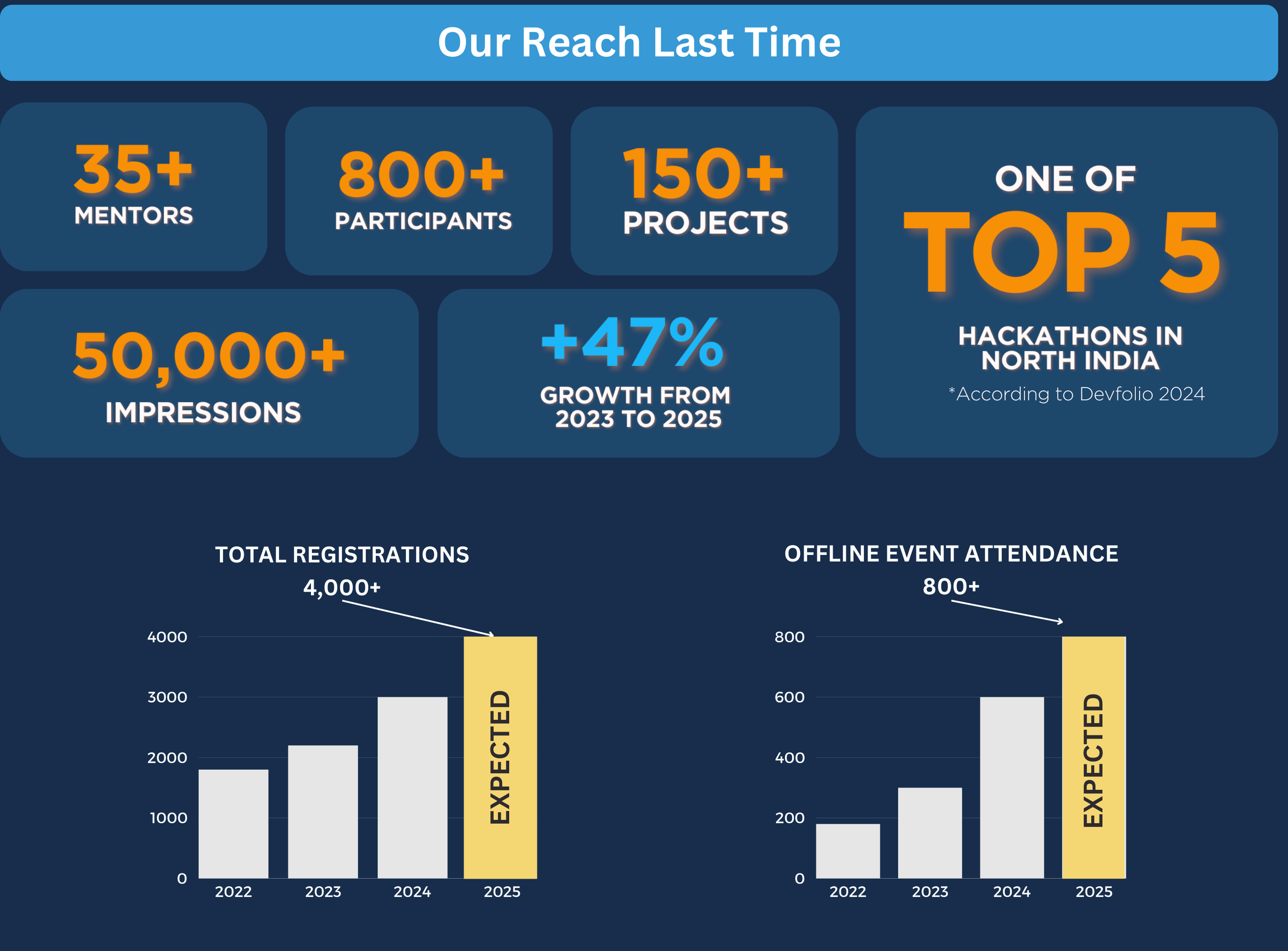
HackTU 6.0
General Secretary · Creative Computing Society · 2025
Thapar’s flagship hackathon, run in collaboration with Major League Hacking. Led the organizing effort across registration, judging, sponsorship and event operations.
3,500 registrations · ~450 on site
Project Details
General Secretary
Creative Computing Society
2025
3,500 registrations · ~450 on site
Society · Web
A hackathon is a logistics problem wearing a technology costume. HackTU 6.0 ran 7–9 February 2025 at Thapar, backed by Major League Hacking — which supports around fifteen events across Asia in a year, and which sends you a rep, a standards bar and a run-of-show template you are expected to actually hit. I led the organizing side of it as CCS General Secretary.
The sixth edition was also the first one that could not be run the way the previous five were. Once a few hundred of the people in the room have travelled to get there, the event stops being a programme and becomes an accommodation problem, a catering problem and a permissions problem, all of which have to be solved weeks before anyone writes a line of code. Nothing about that shows up in the schedule, and all of it decides whether the schedule survives contact with Saturday.
What running it involved
- Two registration funnels. Devfolio as the primary platform, Unstop as the secondary, feeding an idea-submission round that pulled teams from institutions across the country — IITs, NITs, IIITs, DTU, NSUT, VIT, KIIT, SRM and several hundred others, listed out one by one in the proposal. The on-site cohort is a hard shortlist off the back of that, not everyone who registered.
- A minute-level run of show. Roughly 58 scheduled lines from Friday 18:00 check-in through Sunday judging, each tagged public / internal / sponsor and each with a named owner. Hacking starts 11:30 Saturday and hard-stops 23:00 Sunday, with submission announcements beginning ninety minutes before the deadline rather than at it.
- Shift planning for a 24-hour event. Half the organizing team goes to a resting room around midnight and returns at 07:30 so there is a fresh crew running the morning. That single line is the difference between an event that finishes well and one that limps.
- Housing 250 visiting students. Separate boys' and girls' hospitality leads, hostel permissions, escorts, baggage room with tags and a guard, and a day-by-day meal matrix negotiated with the administration across the 7th through the 10th — accommodation for 150 on the Friday rising to 250 on the Saturday, then breakfast and lunch counts tapering back down through the Monday.
- Catering at scale, by hand. 450 dinners, 450 midnight snacks, 450 breakfasts, 450 evening snacks, 150 lunches on each of two days, tea and coffee for 250 — split across Sodexo, a Patiala caterer and Domino's, each with a named contact and a per-unit rate, totalling about ₹1.07 lakh on food alone.
- A full budget sheet. 500 t-shirts, 500 stickers, 450 ID cards, 450 pens, bottles, cheques and mementos at roughly ₹45,000; 130 tables, 500 chairs and 50 mattresses at ₹13,000; stage, 150 power extension points, Wi-Fi and janitorial through campus services. A ₹1.75 lakh prize pool and a ₹36,000 emergency line take the sheet to about ₹3.85 lakh.
- A 19-line logistics register splitting every requirement into what Thapar provides internally and what gets bought outside — LED display, speakers, flex and standees, walkie-talkies, projectors, colour-coded external ID cards, campus maps, on-campus promotion permissions, sponsor and tenting entry clearances, transport for pickup and drop.
- Programme content between the checkpoints. Opening ceremony, sponsor promos, API demos, an MLH slot, an Intro to Hacking workshop, Checkpoint 0 for idea mentorship, and two overnight evaluation checkpoints deliberately scheduled at the hours when attrition is worst.
- A team of around forty, spanning the CCS Executive Board, extended board, core and members, with ownership assigned line by line rather than by committee.
Judging, and why the last ninety minutes are scripted
The closing block is the part of a hackathon most likely to overrun, so it is the part with the tightest schedule. Judging opens at 11:30 Sunday; the hacking floor converts to an expo while it runs; sponsors hand their picks to a single named owner at 14:30 so the announcements are consolidated. The closing ceremony starts at 15:00 and the top ten teams demo from 15:05, three minutes each with one minute of judge questions, ending at 15:55. Deliberation gets twenty-five minutes with sponsor prizes announced inside that window so the room has something to watch. Winners at 16:20, MLH close at 16:27, doors at 16:30. Sponsors keep the venue until 19:00.
Two other things that had to be argued for
Sponsorship was its own document. The deck leads on the society rather than the event — CCS turning twenty, its pre-event footfall, its channel reach — and on what a sponsor actually gets: a curated audience, branding placements, sampling. It carries the previous edition's numbers honestly, including where offline attendance sat against total registrations, because a sponsor who arrives expecting the registration figure in the room is a sponsor you do not get twice.
The institute was the other conversation. The proposal to the Director asked for two specific things: a waiver on hostel accommodation for the 250 visiting students, and breakfast and lunch for them, with CCS committing to fund dinner and both snack services out of its own sanctioned budget. Asking for a defined subset with the rest already paid for is a different request from asking for support. It also fixed the venue window — the floor was needed from Friday evening for setup through late Sunday for teardown, not just for the hours the event was advertised.
What I took from it
The template MLH hands you is not a schedule, it is a list of failure modes other people have already hit. Its margin notes are all of that shape: always have meals arrive fifteen to thirty minutes early because they will be late; schedule mini-events at high-attrition hours; make your own team spend eight hours away from the venue; assume judges will take twenty to thirty minutes to deliberate and have something planned for it; a full hacking-floor-to-expo conversion takes half an hour with volunteers working flat out, so give it more.
Some of it we matched and some we did not — the template wants sponsors in two hours ahead of participants and our schedule gave them thirty minutes. Most of the work was converting each line of it into a named person on our side, and then making sure that person had a fallback. Nothing about the weekend was improvised, which is exactly why it looked relaxed.
Project Details
General Secretary
Creative Computing Society
2025
3,500 registrations · ~450 on site
Society · Web